
Yeast 4. Microscopic Yeast Cell Counting
Master the Method
Method Summary
This is the fundamental method for determining how many yeast cells is in one milliliter of sample, whether it be a yeast slurry, yeast propagation, or fermenter sample. It utilizes a tool called a hemocytometer that makes counting cells much easier due to its gridded pattern. Because of the accurate volume above the counting area, we can determine the number of yeast cells in that area of an appropriately diluted sample and extrapolate to a 1mL volume through the method calculations. This is an important value for determining pitch rate and monitoring fermentations. There are many opportunities for error therefore each step must be performed precisely and consistently
Global Harmonized System (GHS) Information
| Chemical | Hazard Symbol | Signal Word | Hazards Statements |
| 0.5% Sulfuric Acid (H2SO4) |

| Danger | Causes severe skin burns and eye damage. Harmful to aquatic life. |
| 0.5M EDTA |

|
Warning | Causes serious eye irritation |
| 0.5M Sodium Hydroxide (NaOH) |
| Danger | May be corrosive to metals. Causes severe skin burns and eye damage. |
Science Behind the Method
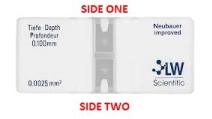
Figure 1 - Click to Enlarge
The hemocytometer is a device that uses a counting chamber with a specific volume in order to calculate the number of cells in one milliliter of a yeast sample.
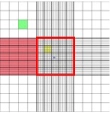
Figure 2 - Click to Enlarge
The volume of liquid directly over the ruled area of the counting chamber where yeast cells will be counted, depicted by the red square, is typically 0.0001cm3 = 1 x 10⁻⁴ cm3 = 0.0001mL or 1 x 10⁻⁴mL. This will need to be recalculated if the dimensions of the chamber are different from what is expressed in the method. The final calculations must therefore be adjusted as well.
Green Chemistry
| Green Action | Principle | Benefit |
| Use EDTA as the deflocculating agent over sulfuric acid |

Safer Solvents | Prevents technicians from using a corrosive and dangerous chemical. |

| ||
| Use glass volumetric pipettes for reagents transfers. |

Prevent Waste | Washing glass volumetric pipettes between each use reduces the need to single-use plastics. |
| Collect waste for proper disposal. | Working with local management for reagent disposal prevents release of hazardous materials to the environment. |
Icons provided by TheNounProject from creator iconsmind.com
Tips & Tricks
Cleaning the Counting Chamber
- If the counting chamber is dirty, the volume of the counting area will be inaccurate, which is the source of erroneous cell counts
Filling the Hemocytometer
- Do not overfill the counting chamber into the side moats. This would indicate that the counting chamber’s volume is no longer 0.0001mL and will produce erroneous cell counts.
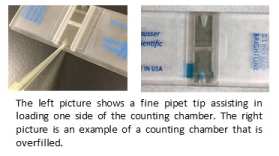
Positioning the Cover Slip
- Cover slips for hemocytometers are different than your normal microscopic cover slips. They are thicker and ensure a proper volumetric filling of the counting chamber.
- Make sure to only use cover slips that are specifically for hemocytometers.
Preparing the Yeast Sample
- It is not recommended to handle brewery yeast samples of less than 1mL
- When performing a dilution, the sample being pipetted must be rinsed out within the tip using the diluent to ensure accurate cell counts.
- A drop of antifoam may be used to assist with degassing the sample.
- Transfer pipettes are not an accurate method of measuring volumes of a yeast sample for dilution and will produce inaccurate and imprecise results.
- Use the table below for guidance on choosing what dilution rate is needed for your sample and how to prepare the dilution. The table is not to be used as a hard and fast rule, but a general starting point. The number of cells on the hemocytometer counting grid must follow the counting rules outlined in the method. If it does not, then you will have to adjust the dilution accordingly and prepare again.
| Expected Cell Count | Suggested Final Dilution Rate | Preparation Guide: Sample (mL) to Water (mL) |
|---|---|---|
| 0-20 Million | 1:20 | 5mL to 95mL |
| 21-50 Million | 1:50 | 2mL to 98mL |
| 51-200 Million | 1:100 | 1mL to 99mL |
| 200 Million + | 1:1000 (1:10 x 1:100) |
Serial Dilution Dilution 1: 10mL to 90mL Dilution 2: 1mL Dilution 1 to 99mL |
Counting
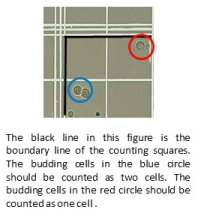
- It does not matter which line counting rules you apply so long as they stay consistent within one laboratory.
- One counting square is surrounded with a three-lined boundary. The counting rules apply to the inside line.
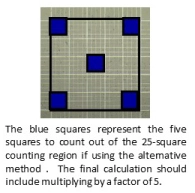
- Although not validated by the ASBC Technical Committee, a quicker alternative method is commonly used within the brewing industry. Rather than counting all of the cells in the entire ruled area of 25 squares, count the four corners and center square, a total of 5 out of 25 counting squares. A multiplication of 5 must be applied to the final calculation. Counts from both sides of the slide should agree within 10%. Standardized counting technique must be used. It is advised to perform an in-house validation if this alternative method is used to determine variability and number of total counts needed to reach a statistically valid result.
Calculations
- The 104 factor within the equation represents how many times the volume of the ruled counting area goes into one milliliter in order to get end results in units of cells/mL.
ASBC Resources
- To calculate pitch rate, the viability of the yeast sample must be determined. Follow MOA Yeast 3a
- Yeast Cell Counting: ASBC Webinars
- Yeast Management Processes Impacting Yeast Viability & Vitality: Pitching
Other Resources
Method Masters
A Big Thanks To...
Rob Christiansen, Liz Nagle, Krystin Norman, Joe Palausky, Robert Fulwiler, Katie Fromuth