
Beer 8. Total Acidity as 'Titratable Acidity'
Master the Method
Method Summary
Global Harmonized System (GHS) Information
| Chemical | Hazard Symbol | Signal Word | Hazards Statements |
| pH Buffer 10.0 |

| Danger | Reproductive toxicity. May damage fertility or the unborn child. |
| Phenolphthalein solution (1% in ethanol) |


| Danger | May cause cancer. Flammable liquid and vapor, causes serious eye irritation, suspected of causing genetic defects |
Science Behind the Method
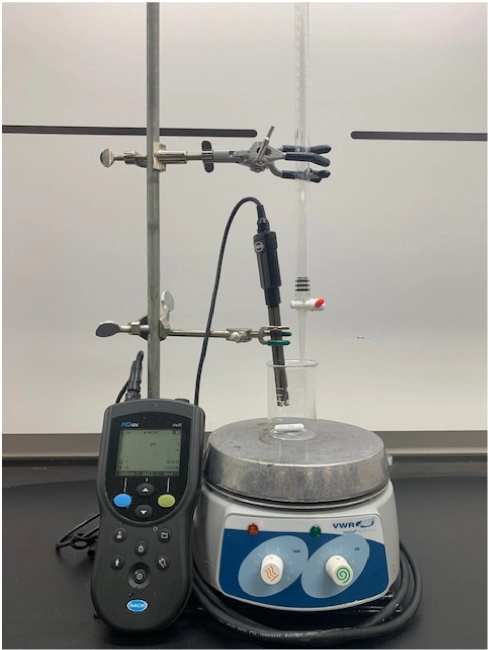
Figure 1 - Click to Enlarge
A titration is a lab method where a solution of a known concentration (the titrant) is used to determine the concentration of an unknown solution (the titrand). In this method the titrant is 0.1M sodium hydroxide and the titrand is the beer sample. The set up looks similar to what is shown in Figure 1.
This method describes a weak acid – strong base titration. This is where a strong base (sodium hydroxide) is added to a solution containing a weak acid (beer sample) until all of the acid’s hydrogens have been neutralized. Neutralization is the quantitative process where the hydrogen ions (H+) of the acid and the hydroxide ions (OH-) of the base react to form water and a salt until no more acid is left in solution.
acid + base → salt + water
HCl + NaOH → NaCl + H2O
The pH of when this point occurs, known at the equivalence point, depends on the strength of the acid within the reaction and is not always a neutral pH of 7.
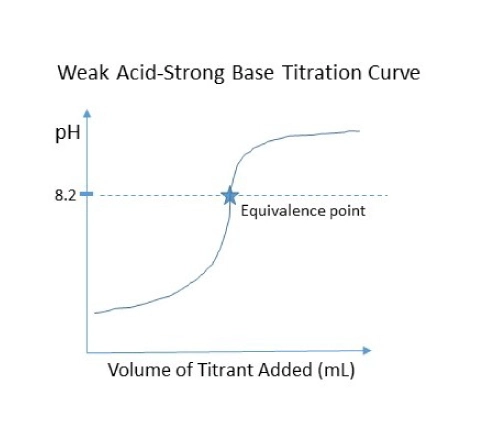
Figure 2 - Click to Enlarge
The equivalence point is also called the end point of the titration. In a weak acid-strong base titration the equivalence point is greater than pH 7. In this method the equivalence point is reached at 8.2 pH. A titration curve plots the pH vs. the volume of the titrant added (Figure 2), where the equivalence point is the middle vertical spot on the curve. Notice how the rate of pH increase quickens the closer it gets to the equivalence point. In practice this means the pH will increase faster the closer to the end point and is the reason why the method describes adding smaller volumes once pH 7.6 is reached. This can’t be determined if using the indicator method.
There are many indicators available for titrations but for this method phenolphthalein is the best choice if a pH meter cannot be used because it changes color and appears magenta under basic conditions in the range of 8.2 -10 pH, which is this method’s equivalence point. Once the titration has reached its equivalence a small excess amount of the base will create a basic environment in which the indicator is will appear magenta, signaling the end point of the titration.
Organic acids that lead to flavor characteristics in beer (for example: lactic, acetic, malic, and citric acid) are considered weak acids and they do not dissociate completely. This means that not all of the hydrogens/protons on the molecule will unbind and react with the base that is working to neutralize the solution in a titration.
HA ↔ A- + H+
During the titration process, all of the acidic hydrogens from all organic acids in the solution are reacting with the base resulting in titratable acidity. Although this value can be represented in units of a specific organic acid (for example: g/L or percent % lactic acid), it does not mean that all of the acids in solution are lactic acid. This is misleading but it is one way to report the results.
The correction factors come from the molar mass of each organic acid divided by the number of acidic protons, where the acidic protons are the hydrogens in an acid what will dissociate. This is described in Table 1.
| Acid | Molar Mass (g/mol) | # Acidic Protons | Factor (Molar Mass/Acidic Proton) |
|---|---|---|---|
| Lactic | 90 | 1 | 90 |
| Acetic | 60 | 1 | 60 |
| Malic | 134 | 2 | 67 |
| Citric | 192 | 3 | 64 |
Table 1
Green Chemistry
| Green Action | Principle | Benefit |
| Choose to determine TA by pH meter |

Safer Solvents | Removes the use of Phenolphthalein, a hazardous chemical |

Energy Efficient | Removes the use of a heating mantle/hot plate | |
 Prevent Waste | Removes the use of distilled water | |

Prevent Accidents | Removes hot glass and hazardous chemicals |
Image credit: iconsmind.com
Tips & Tricks
- Use a larger buret for beers that are highly soured and acidic. It might be necessary to fill the buret a second time.
- It might be necessary to use a collection beaker larger than 100mL if the sample is highly acidic and more base is required to reach the end point.
- A lab stand and clamps are needed for the titration set up. At least one clamp is needed to affix the buret to the stand and one to hold the pH probe in place above stir bar.
- For safe chemical handling, use a funnel that fits inside the diameter of the buret to pour in the sodium hydroxide.
- Make sure the stopcock on the buret is closed before adding the sodium hydroxide.
- The top of the buret is marked with a 0mL graduation and at the bottom is the last graduation indicating its capacity. This graduation will be above the stopcock so an immeasurable amount of liquid will remain in the buret after the last graduation. Make sure to not go past the last graduation on the buret if needing to refill the buret with base to reach the endpoint.
- Mixing is a critical step in the method to ensure that the base is reacting with the acid in solution. Allow the sample to mix long enough for the reaction to complete after each addition of base.
- This method cannot separate and quantify the different organic acids present in solution. If you wish to quantify individual organic acids a High Performance Liquid Chromatography (HPLC) instrument or an enzymatic kit (such as Megazyme products) must be used.
- Determining end point by pH is more accurate than using an indicator. The indicator is more subjective and therefore there is a greater chance for error in interpreting when the endpoint is reached.
- The sodium hydroxide titrant should be standardized against a primary standard (potassium acid phthalate or other) before use. Refer to Other Resources #3.
ASBC Resources
Method Masters
Big Thanks to...
Ann Sandbrook, Joe Palausky, Dana Garves & Katie Fromuth